Before You Begin: Gear Up for Success
The other evening, I was trying to get Buster, my food-hoover of a Labrador, to do something more sophisticated than just ‘sit’ for the hundredth time. He just stared at me, then at the treat cupboard, as if to say, “The transaction is simple, human. Why complicate it?” It got me thinking. Teaching a new trick like ‘roll over’ isn’t complicated, but you do need to set the stage properly. Forget fancy gear; this is about practicality.
All you really need are two things:
- High-Value Treats: I’m not talking about their usual dry kibble. You need the good stuff. Think tiny cubes of cheese, bits of cooked chicken, or those smelly fish treats that make you wish you’d lost your sense of smell. The goal is to make it worth their while. For Buster, cheese is currency.
- A Comfy, Quiet Space: A soft rug or carpet is ideal. Avoid slippery floors like laminate or tiles, as it can be physically tricky for them to get the right grip to roll. Keep distractions to a minimum—so maybe don’t try this when the postman is due.
First Things First: Mastering the “Down” Command
Right, let’s not try to run before we can walk. The ‘roll over’ trick is built directly on the ‘down’ command. Your dog needs to be able to lie down calmly on cue before you can possibly ask them to roll from that position. It’s the foundation of the entire manoeuvre.
If your dog hasn’t quite got the hang of ‘down’ or ‘lie down’ yet, spend a few training sessions on that first. It’s the essential starting position for this party trick.
How to Teach Your Dog to Roll Over: The Four Key Steps
Patience is your best friend here. Some dogs, like my hyperactive Spaniel, Fern, might get it in a few tries. Others might take a few weeks. The key is breaking it down into manageable chunks using a technique called luring—using a treat to guide their movement.
Step 1: Luring From ‘Down’ to Their Side
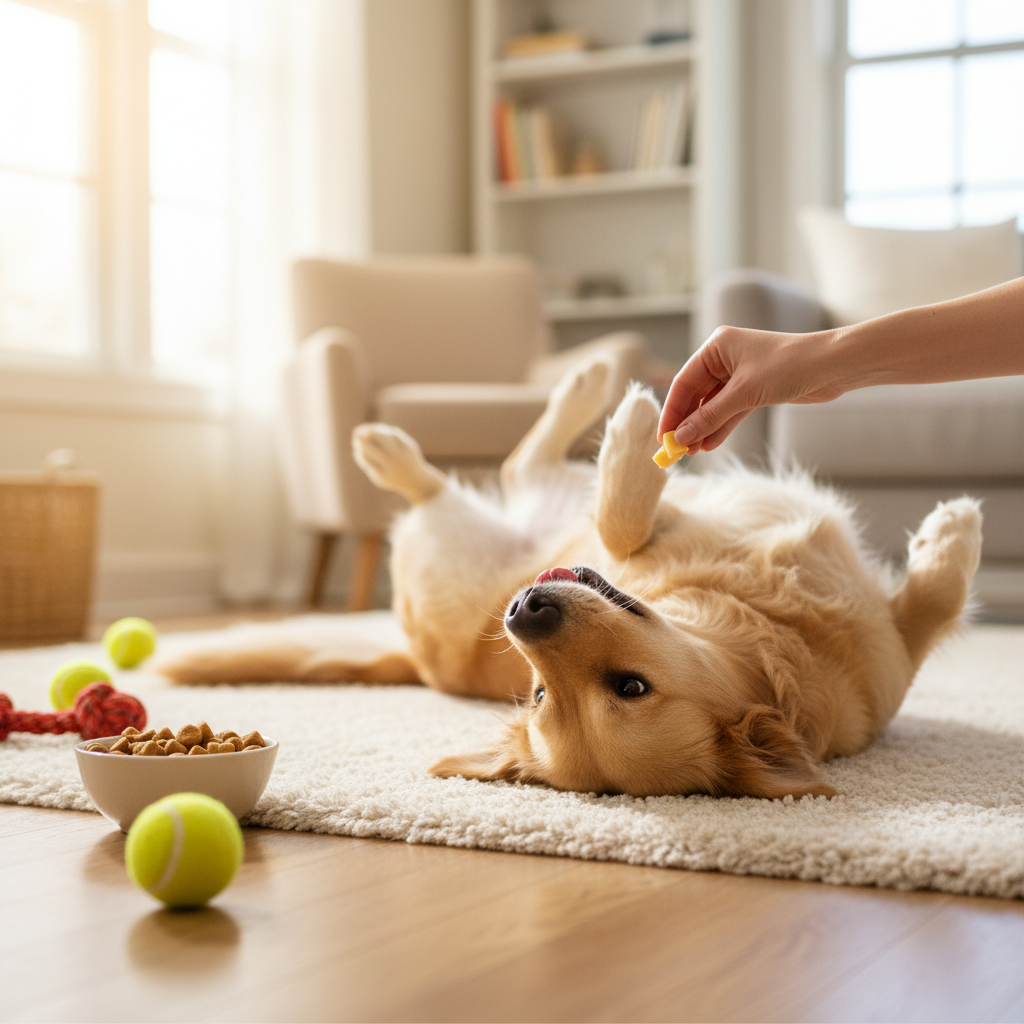
Start with your dog in the ‘down’ position. Hold a high-value treat in your hand, make a fist, and let them have a good sniff of it.
- Place your fist with the treat right by their nose.
- Slowly move your hand from their nose towards their shoulder, encouraging their head to follow the treat.
- To follow the treat, they will have to shift their weight and lie on their side. The very moment they do, say “Yes!” and give them the treat.
Key Takeaway: Repeat this several times until your dog is comfortably flopping onto their side to follow the treat lure. Don’t move on until this step is solid.
Step 2: Encouraging the Full Tummy-Up Roll
Once they’re a pro at lying on their side, it’s time to encourage the full roll. The motion is a continuation of the first step.
- Get them onto their side as before.
- Instead of giving the treat straight away, continue the lure from their shoulder, up and over their backbone.
- This should encourage them to roll right over onto their other side to follow the treat.
This is often the trickiest part. At first, reward any effort—a lean over the back, a lift of the leg. As soon as they make it all the way over, give them lots of praise and the treat. You’re teaching a complex chain of movements.
Step 3: Adding the Verbal Cue (“Roll Over!”)
When your dog is reliably rolling over using the hand lure, it’s time to give the trick a name. Just before you start the luring motion with your hand, say your chosen cue word clearly. “Roll Over!” is the classic.
- Say “Roll Over!”
- Immediately perform the hand lure motion.
- Praise and treat when they complete the roll.
By saying the word just before the action, your dog will start to associate the verbal cue with the movement they are about to perform.
Step 4: Fading the Treat Lure
The final step is to remove your hand’s reliance on the treat. You want the dog to respond to the verbal cue and a hand signal, not just the smell of cheese in your fist.
- Start making the same hand motion as before, but without a treat in your hand. Give the verbal cue first.
- When they complete the roll, praise them enthusiastically and then give them a treat from your *other* hand.
- Gradually make your hand signal smaller and smaller, until hopefully, they respond to the verbal cue alone.
Hit a Snag? Common Sticking Points and How to Fix Them
It’s not always a walk in the park. My rescue cat, Margo, watches from her radiator perch with what I can only assume is deep judgment if a training session goes awry. Here’s how to handle common problems.
- My dog just won’t lie on their back. This is very common. Lying on their back is a vulnerable position, and not all dogs are comfortable with it. Never force them. Go back to rewarding them for lying on their side. Then, reward for any tiny lean towards their back. This might take many short sessions to build their confidence.
- They just jump up instead of rolling. This usually means they are a bit too excited or confused. The training session may have gone on too long. End it on a positive note with a simple ‘sit’ or ‘down’, and try again tomorrow for a shorter period.
- They get stuck on their side and won’t go further. Your treat might be too high. Make sure you are luring their nose towards their spine, not up towards the ceiling. Keep the lure low and tight to their body.
Top Tips for a Happy Training Session
- Keep it short and sweet. A few minutes, a couple of times a day, is far more effective than one long, frustrating half-hour session. End before they get bored.
- Patience is your superpower. Every dog learns at a different pace. Don’t compare them to anyone else’s dog. This is about having fun with your own pooch.
- Always end on a high. Finish each session with a successful command, even if it’s just a simple ‘sit’. This keeps their confidence up and ensures they look forward to the next session.
Your “Roll Over” Questions Answered (FAQ)
What if my dog doesn’t like treats?
While less common, some dogs are more motivated by praise or a favourite toy. You can try using a squeaky toy as a lure in the same way you’d use a treat, offering a quick game of tug as a reward when they get it right.
How long will it take to teach my dog to roll over?
That’s the million-pound question! It could be a day, it could be a month. It depends entirely on the dog’s personality, confidence, and how consistently you practice. The journey is part of the fun, so don’t focus on the clock.
Is it okay if my dog only rolls over in one direction?
Absolutely! Most dogs (and people) have a preferred, more coordinated side. It’s perfectly fine if they only ever roll over from right to left, for example. There are no extra points for being ambidextrous in the world of dog tricks.

Related Posts